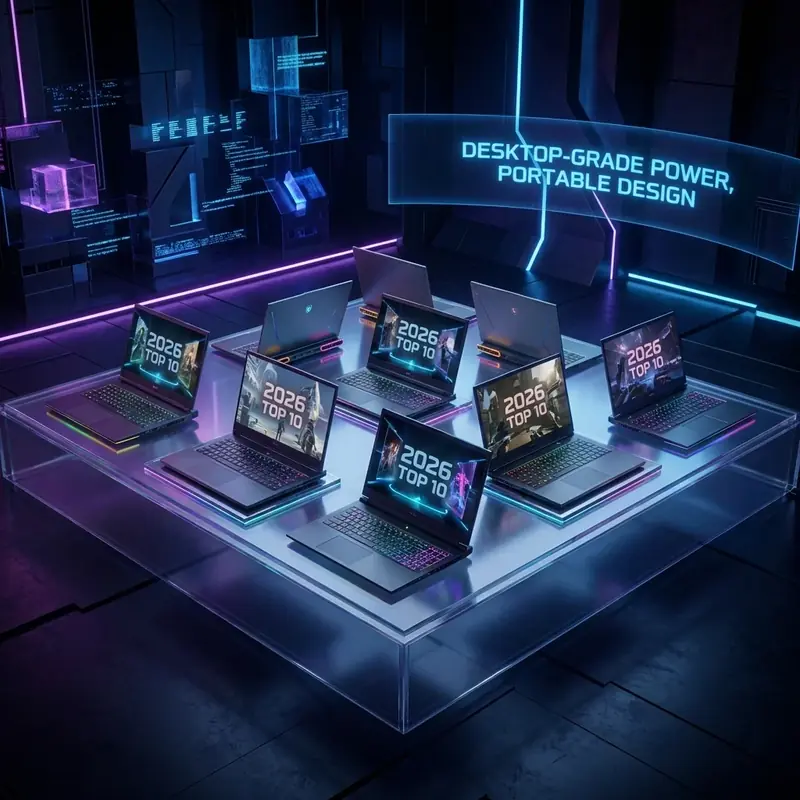
The year 2026 brings a new generation of gaming notebooks, many packing desktop-grade power into portable designs. With Nvidia’s latest RTX 50-series GPUs (like the RTX 5090) at high power budgets and next-gen Intel/AMD CPUs, 4K ray-traced gaming and advanced AI workloads are now feasible on laptops. Reviewers agree this is a “turning point in portable performance,” where machines balance raw frame rates with efficient cooling, long battery life, and quality builds. Below we list the year’s top 10 gaming laptops, from flagship powerhouses to smart budget picks, each chosen for its combination of performance, features, and value.
1. Razer Blade 18 (2025) – Best Overall
The Razer Blade 18 leads the pack with chart-topping performance and a unique dual-mode display. Its 18-inch screen can switch between 4K 240 Hz and 1080p 440 Hz modes, offering both stunning detail and ultra-fast gameplay. With an Intel Core Ultra 9 275HX CPU and Nvidia RTX 5090 GPU, it outperformed nearly every competitor, even beating the previous champion MSI Titan 18 HX in tests. Built to a high standard, the Blade 18 includes Thunderbolt 5 ports and a premium keyboard/touchpad, though it comes with an “eye-watering” price tag. In short, if you want the best of the best and can afford it, the Blade 18 delivers unmatched gaming power and quality.
2. MSI Titan 18 HX AI (2026) – Ultimate Powerhouse
MSI’s Titan 18 HX AI is a true desktop-replacement laptop built for extreme performance. It pairs a 24 GB RTX 5090 GPU with Intel Ultra 9 285HX CPU and advanced AI-assisted cooling. In fact, testers note this Titan can outperform some desktop RTX 4090 systems under demanding settings. The generous cooling and “OverBoost Ultra” power limit (up to 270 W!) help sustain peak FPS for long sessions. However, this fire-breathing beast is heavy and bulky – it’s meant to stay on a desk rather than travel in a backpack. Its strength is sheer power: if you need maximum performance without regard for weight or cost, the Titan 18 HX AI reigns supreme.
3. Lenovo Legion Pro 7i Gen 10 (2026) – Smart Thermal Design
Lenovo’s Legion Pro 7i Gen 10 takes a different approach by optimizing cooling. Its vapor-chamber thermal solution lets the RTX 5080 GPU and Ultra 9 CPU sustain higher clocks than rival laptops with similar specs. In benchmarks, this intelligent design “outperforms expectations” for its hardware, making the Legion one of the best gaming laptops of 2026. The Legion Pro also offers a sturdy chassis and a high-quality 16″ display. For gamers who prioritize consistent, throttling-free performance over flashy RGB, the Legion Pro 7i is a top choice.
4. Gigabyte Aorus 16X (2024) – Best Midrange Value
Gigabyte’s Aorus 16X strikes an excellent value balance. In our tests, a $1,599 configuration (Core i7-14650HX + RTX 4070 + 32 GB RAM + 1 TB SSD) delivered smooth gaming on its 16″ 2560×1600 IPS display at 165 Hz. The screen is vibrant and sharp, ideal for high-resolution gaming. Beyond raw specs, the Aorus 16X includes Thunderbolt 4, Wi-Fi 7, and even room for a second NVMe drive – features often missing at this price. In summary, the 16X gives you flagship-like hardware in a well-built package without breaking the bank, making it one of the year’s best midrange picks.
5. Acer Predator Triton 14 AI (2026) – Lightweight Performer
Acer’s Predator Triton 14 AI delivers capable gaming in an ultraportable form. Weighing just 3.5 lbs with a 0.71″ chassis, it packs an Intel Core Ultra 9 288V and an RTX 5070 GPU. Despite its slender build, it “delivered capable gaming performance” on demanding titles in benchmark tests. Reviewers praise its design as “lightweight, sleek, and great for creators and gamers alike”. The Triton’s 14.5″ OLED touch display is vivid (covering ~192% sRGB) and it includes features like stylus support and Nvidia Studio drivers for content creation. In short, the Triton 14 AI is one of the nicest lightweight gaming laptops around – it sacrifices some CPU power (the 8-core 288V) but rewards you with high-end gaming on the go.
6. Asus TUF Gaming A14 (2024) – Excellent 14″ Value
The Asus TUF Gaming A14 proves a 14-inch laptop can still game well. In our tests, its Ryzen 7 7845HS (AMD 8845HS) CPU and 100 W RTX 4060 GPU delivered solid 1080p gaming while keeping weight to just 3.22 lbs and 0.78″ thickness. Reviewers note that despite its modest specs, the A14 “feels premium” and is “one of the most compact and lightest 14-inch laptops,” with great battery life (over 10 hours in light use). The design is subdued (no flashy RGB on the outside) and build quality is good. The main compromise is the sound: the speakers are quiet, so gamers will want a headset. If you need ultimate portability with respectable gaming chops, the TUF A14 is hard to beat for its price.
7. Alienware 16 Area-51 (2026) – Desktop Replacement
Dell’s Alienware 16 Area-51 is a chunky 16-inch powerhouse meant to stay plugged in. It packs an Intel Ultra 9 275HX and an RTX 5080 GPU under the hood, delivering “strong gaming performance” that rivals the best laptops. One standout feature is the optional Cherry MX mechanical keyboard – a rare premium upgrade that gamers love. However, this machine is heavy (about 7.49 lbs and 1.12″ thick). As reviewers put it, you “can carry it around, but you may want to just leave it in your home” due to its size. The Alienware 16 is ideal if you want desktop-grade FPS and lots of ports, and don’t mind the bulk.
8. ASUS ROG Zephyrus G16 (2024) – Portable Powerhouse
The ROG Zephyrus G16 (2024 model) balances speed with mobility. It packs an AMD Ryzen AI 9 processor and an RTX 5080 GPU into a chassis under 4.5 lbs. Its 16″ OLED display runs at 240 Hz, making it excellent for esports and content creation alike. Remarkably, even with such high-end hardware, the G16 achieves about 8 hours of light use on a charge – one of the few gaming laptops that can match large notebooks in battery life. In sum, the Zephyrus G16 is a “lightweight powerhouse” that delivers near-desktop performance without sacrificing portability.
9. HP Omen Max 16 (2025/26 Refresh) – High Performance at Value
HP’s refreshed Omen Max 16 offers top-tier specs at a lower price. Configured with an RTX 5090 at 175 W, it can push almost flagship-level performance. Reviewers note that the Omen Max 16 matches the performance of more expensive models while undercutting them on cost. HP also upgraded its cooling, allowing the Max 16 to sustain high frame rates without thermal throttling. In short, the Omen Max 16 is a great “value meets performance” pick for gamers who want RTX 50-series power without the alien appearance or budget of other premium laptops.
10. MSI Katana 15 HX (2024) – Best Budget Option
The MSI Katana 15 HX is a true budget gaming laptop (around $1,000) that surprisingly uses current-gen parts. It pairs an Intel Core i7-14650HX with an RTX 5050 GPU, delivering solid 1080p gaming performance for its price. The Katana’s four-zone RGB keyboard and upgradeable components (replaceable RAM/SSD) punch above its weight class. Its main weakness is the 15.6″ screen – it’s dim and color-poor, so games won’t look very vibrant. Still, for under $1K this machine “offered solid 1080p performance” in benchmarks, making it our top budget pick. If you’re on a tight budget, the Katana 15 HX provides up-to-date gaming hardware in a no-frills package.
What to Look For in a 2026 Gaming Laptop
When shopping, keep in mind the big advances of 2026: performance and efficiency have both improved. Beyond raw specs, prioritize thermal design and sustained power – a laptop with dual fans or vapor-chamber cooling can maintain higher GPU/CPU wattages for longer.
Likewise, invest in a high-quality display: the best gaming laptops pair powerful GPUs with fast OLED or Mini-LED panels (144–240 Hz) for smooth, vibrant visuals. Consider the trade-off between portability and power – heavy machines like the MSI Titan deliver unmatched performance but sacrifice mobility, whereas thin-and-light designs (like the Zephyrus G16) trade a bit of top-end speed for easier carry.
Finally, if you need any battery life for non-gaming use, look at how efficient the laptop is: only a few models (e.g. the Zephyrus G16 or Legion Pro series) achieve significant runtimes on battery even with high-end components. By balancing these factors – cooling, display quality, weight, and battery – you can choose the gaming laptop that best fits your needs and play style.